
The Rise in Neurodivergent Children:
What the Numbers Really Show — and Where New Wings Comes In
Understanding the data behind a growing conversation — and how our online School Readiness Program responds to it
A decade ago, most parents had never heard the word “neurodivergent.” Today, it comes up in parent WhatsApp groups, at pediatrician visits, and in staffroom conversations at schools across India’s major cities — Bengaluru, Mumbai, Delhi, Chennai, Hyderabad, and beyond. That shift isn’t just a change in vocabulary. It reflects a real, measurable change in how many children are being identified with autism, ADHD, learning differences, and other developmental conditions — and how early that identification is now happening.
At New Wings, we sit at the center of that shift every day. Before talking about what we do, it’s worth looking honestly at the numbers behind it.
How much has the picture actually changed?
The most closely tracked figure in the world is the U.S. CDC’s autism prevalence data, collected every two years from the same network of surveillance sites. In 2000, the estimated rate was 1 in 150 children. By 2018, that had risen to about 1 in 44. The most recent data, covering children born in 2014 and released in 2025, puts the figure at roughly 1 in 31, or 3.2% of eight-year-olds.
Boys continue to be identified at a far higher rate than girls — about 1 in 20, compared with roughly 1 in 70 for girls. And autism is only part of the picture: a separate CDC study found that about 1 in 6 children (17%) between ages 3 and 17 in the U.S. has been diagnosed with at least one developmental disability, a category that includes ADHD, learning disorders, and more. Globally, a 2025 meta-analysis pooling 66 studies and over 21 million children put worldwide autism prevalence at 0.77%, while the World Health Organization’s working estimate is roughly 1 in 100 children.
What the data shows closer to home
India’s numbers tell a similar story, though good data has taken longer to arrive. The most rigorous study to date is a 2018 community-based survey led by the INCLEN Trust, published in PLOS Medicine — researchers went door-to-door across five regions of India, directly assessing nearly 4,000 children, rather than relying on hospital records or self-reporting. They found that about 1 in 100 children under age 10 had autism, and close to 1 in 8 had at least one neurodevelopmental condition — with hearing impairment and intellectual disability the most common, and nearly one in five affected children carrying a second, overlapping condition. That neurodevelopmental figure was roughly ten times higher than the 1.3% recorded in India’s 2011 census, which the study’s lead author described as a significant undercount — a gap researchers attributed largely to how rarely these conditions had been actively screened for before. Rates also varied sharply by region, from 0.4% in North Goa to 1.8% in rural Palwal.
More recent reviews point the same direction: a 2024 analysis estimated autism affects roughly 1 in 65 Indian children aged 2 to 9, translating to an estimated 1.8–2 million children nationally. ADHD estimates vary widely depending on the city and screening tool used, but school-based studies have found rates from roughly 5% to well over 10% — 9.6% among primary schoolers in Hyderabad, 11.3% in Coimbatore, and 5.7% in Belagavi, Karnataka. Learning differences add another layer: dyslexia is estimated to affect 7–10% of any population, and 8–9% of Indian children show signs of dyscalculia or dysgraphia.
None of this is happening in a system with enough hands to meet it. As of 2023–24, India had identified more than 25 lakh children with special needs, yet only an estimated 12,000–15,000 trained special educators were available nationwide to support them. That gap holds true across the country’s major cities as much as its smaller towns, and it’s precisely why structured, specialist-led programs that families can reach from anywhere have become so necessary.
Why are the numbers climbing?
It’s a fair question, and the honest answer is nuanced. Researchers generally attribute the rise to a combination of factors rather than a single cause: broader diagnostic criteria (autism-related conditions that were once diagnosed separately are now grouped under one spectrum), expanded screening recommendations, and growing awareness among parents, teachers, and pediatricians. Better healthcare access has also brought diagnosis to communities and regions that were historically underserved and undercounted. Most experts see this less as an “epidemic” and more as a correction — children who would once have gone unrecognized, quietly struggling, are now being seen.
That correction matters enormously, because being seen early is what makes the biggest difference.
The science of timing
A young child’s brain has around 50% more neural connections than an adult brain does, before a natural pruning process thins these out through adolescence. This is the biological window that makes early intervention so much more than a nice-to-have: the same input — a structured learning session, a repeated routine, a consistent way of building a skill — has more power to reshape developing neural pathways in a five-year-old than in a fifteen-year-old.
India’s own health system is built on this principle. The government’s Rashtriya Bal Swasthya Karyakram screens every child from birth to 18 for what it calls the “4 D’s” — Defects, Deficiencies, Diseases, and Developmental delays — specifically so that autism, ADHD, and learning disorders can be flagged and referred as early as possible. The logic is simple and well-established: the earlier a developmental difference is identified, the more time there is to build foundational skills before a child is expected to sit through a full school day, follow multi-step instructions, and navigate friendships largely on their own.
The problem most families face isn’t disagreeing with that logic. It’s finding a program that actually delivers on it, consistently, in a way that connects real, structured skill-building to classroom readiness.
Where New Wings fits into this window
This is exactly the gap our online School Readiness Program was built to close.
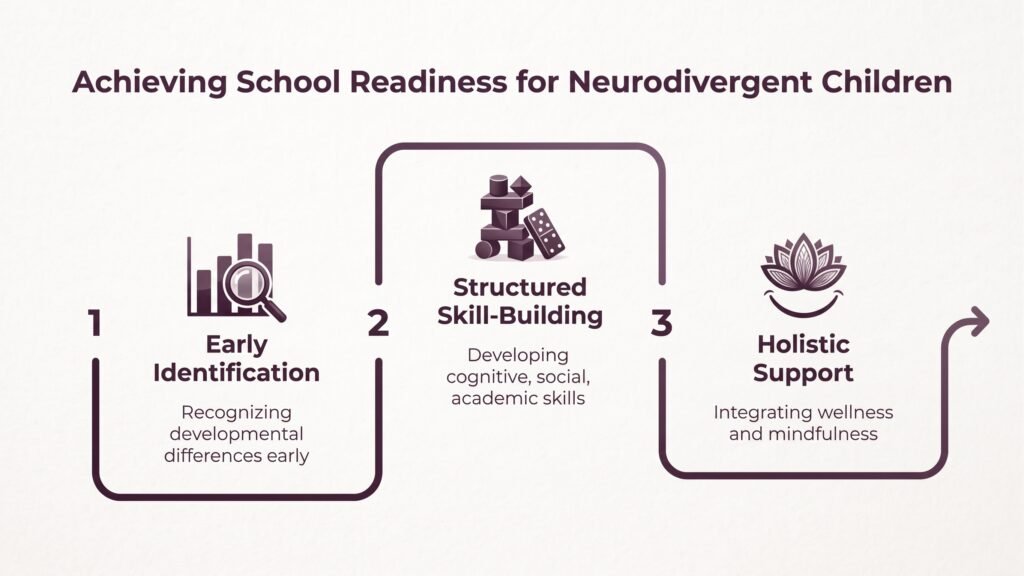
We work with children aged six and above who need more time and a different pace than a typical classroom allows — building the cognitive, social, behavioral, and academic skills required to move into an inclusive school environment with real confidence, not just on paper. What makes this work is that it isn’t a single service. It’s a connected path.
For our youngest or newest learners, the focus starts with individualized, structured skill-building — communication, motor, and social skills — delivered online, one-on-one or in small groups, building the foundations everything else depends on. As those foundations take hold, we layer in structured pre-academic work — early literacy, numbers, fine motor tasks — alongside continued skill-building sessions and guided peer interaction, so academic skills and social comfort grow together rather than in isolation. The final stage is the one most parents are working toward from day one: active preparation for a mainstream classroom, including direct coordination with the receiving school to make the handover as smooth as possible.
Two things about how we deliver this are worth calling out. The entire program runs online, with a few intensity levels — from twice a week for a child just starting out, up to daily evening sessions for children who benefit from frequent repetition — so families can join from anywhere in India, whether they’re in Bengaluru or a town without a specialist center nearby. And we don’t treat readiness as a fixed timeline. Every child’s plan is paced to what they need, not to a school-year calendar, with progress tracked closely by the same team throughout.
We’ve also built in something less common: weekly online Ayurvedic wellness and mindfulness sessions, delivered in partnership with Vibrational Alchemy, alongside simple nutrition and movement routines woven into the day. The evidence on early intervention is clear that outcomes improve when a child’s whole system — not just the target skill — is supported. That’s the standard we’ve tried to build toward.
The bottom line
The rise in neurodivergent children being identified across India’s cities isn’t a crisis to fear — it’s a signal that more families finally have language and data to describe what they were already noticing. What happens in the months right after that recognition is what determines how much of a difference it makes. That’s the window we exist for.
If you’ve noticed your child needs a different pace to get ready for school, the earliest possible step — through a program like our online School Readiness Program — is usually the one that matters most.
Sources
World Health Organization — Autism spectrum disorders fact sheet
Regional school-based ADHD prevalence studies — Hyderabad (Annals of Child Neurology, 2024), Coimbatore, and Belagavi, Karnataka
Osong Public Health and Research Perspectives — global ASD meta-analysis, 2025